When temperature becomes the real limit
In most lightweight applications, the first question is always about strength. But there’s a second limit that decides whether a part survives in the real world: temperature. A drone flying under the sun, a bracket near a motor, a tool working close to a heat source, many components fail not because they’re too weak, but because the polymer holding them together softens long before the load does.
So, we put it to the test. We took five rods and asked one direct question: how much temperature can each one support while carrying a load? Let’s test it.
Five rods, one oven, the same load
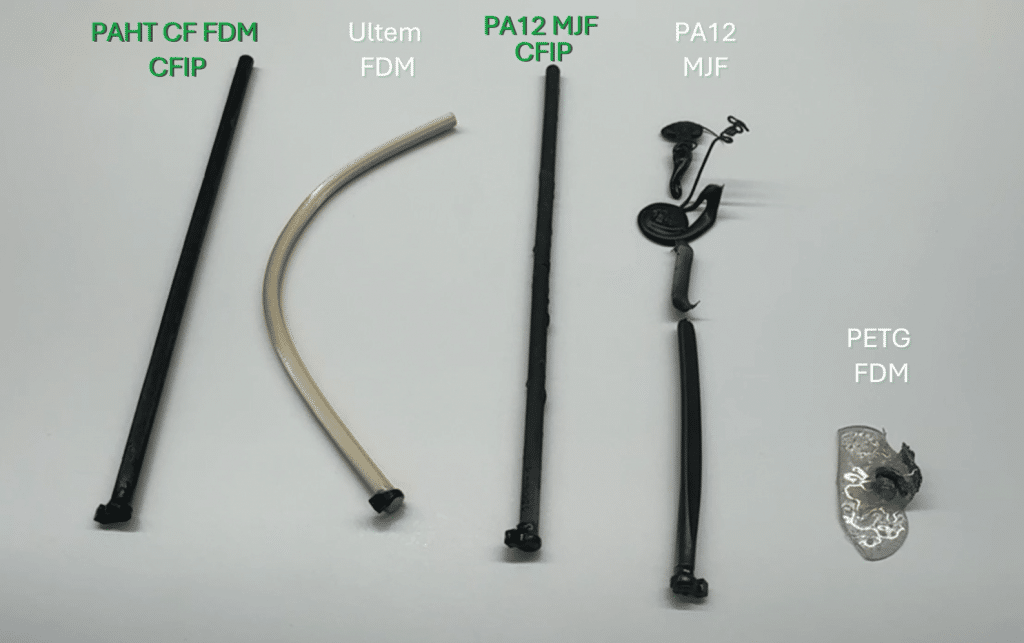
We took five rods with identical geometry ø 8 mm, L = 300 mm, and hung the same weight from each one 0.5 kg, then placed them inside an oven and let the temperature climb. From outside, the setup was simple. The difference was entirely in how each rod was made and reinforced:
- PETG FDM — a common, accessible printing material
- PA12 MJF — a widely used industrial polymer
- Ultem FDM — a high-performance, engineering-grade polymer
- PAHT CF FDM + CFIP — a FDM shell reinforced internally with CFIP
- PA12 MJF + CFIP — an MJF shell reinforced internally with CFIP
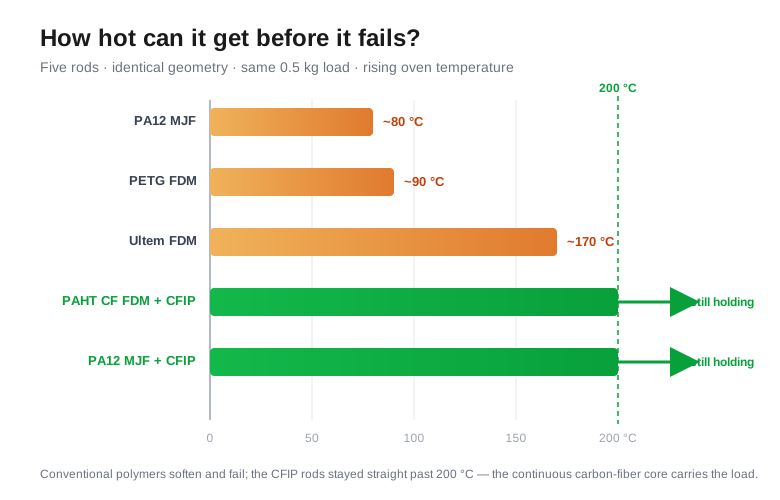
The failures came one after another, each at its own temperature. The PA12 MJF rod was the first to surrender, deforming and dropping its load at around 80 °C. The PETG FDM rod followed shortly after, collapsing at roughly 90 °C and eventually melting into a shapeless mass. The Ultem FDM rod held far longer, as expected from an engineering-grade polymer, but even it bent into a curve and gave up its weight at about 170 °C.
The two CFIP rods told a completely different story. Past 200 °C, both the PAHT CF FDM + CFIP and the PA12 MJF + CFIP rods remained perfectly straight, still holding their weight as if nothing had happened.
| Rod | Failure | Result |
| PA12 MJF | ~80 °C | First to fail — deformed and dropped the load |
| PETG FDM | ~90 °C | Collapsed and melted into a shapeless mass |
| Ultem FDM | ~170 °C | Bent into a curve and released the weight |
| PAHT CF FDM + CFIP | >200 °C | Stayed perfectly straight, still holding |
| PA12 MJF + CFIP | >200 °C | Stayed perfectly straight, still holding |
Why CFIP holds when others melt
The explanation is in architecture. In a conventional printed part, the polymer carries the load. As temperature rises, that polymer softens, loses stiffness and eventually flows — and the part fails, no matter how well it was printed.
With CFIP, the load is carried by a continuous carbon-fiber core running through the inside of the part. Carbon fiber doesn’t soften at the temperatures that destroy these polymers; it keeps stiffness and its shape. The printed shell defines the geometry, but the fiber does the structural work, which is exactly why the CFIP rods stayed straight while the others deformed.
The implications go well beyond an oven. UAV components can keep their integrity under solar heating and sustained flight. Automotive and engine-bay parts can hold structural loads in hot environments. Tooling and industrial fixtures can operate close to heat sources without losing precision. Anywhere temperature is the real ceiling on performance, placing a continuous fiber where the load travels change what a printed part can do.
Five rods, same size, same load, rising heat — and only one technology left standing. When strength comes from the inside, the answer changes. This is a clear demonstration of the immense potential of CFIP to enable lightweight, high‑temperature applications.