
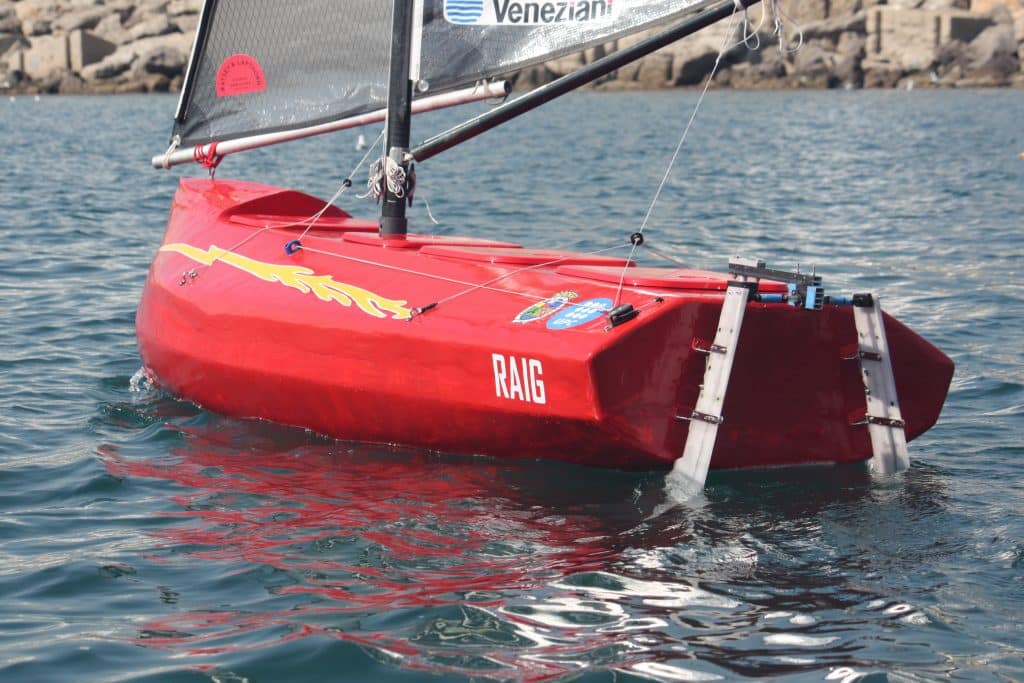
A 2.95-meter monohull sailed itself across the Bay of Sant Antoni de Portmany on April 5th. No crew, no remote operator. It was the fastest boat in the exhibition race.
That’s the Raig FNB — an autonomous sailboat designed and built by 26 engineering students from the Facultat de Nàutica de Barcelona (UPC) over the past nine months. We didn’t just sponsor the project. We manufactured one of its most structurally critical components.
The rudders: why they matter on an autonomous vessel
On a crewed boat, a rudder showing early signs of delamination or fatigue gets noticed. Someone feels it, flags it, the race stops. On an autonomous vessel, there’s no one on board to catch that. The component has to perform for the entire route without intervention, across variable sea states, cyclic hydrodynamic loading, and salt water exposure throughout.
That’s the brief we worked from. Reinforce3D produced the Raig FNB’s rudders using CFIP (Continuous Fiber Injection Process), our core manufacturing technology. CFIP places continuous fiber reinforcement precisely within the part geometry, achieving structural performance that short-fiber or conventional hand layup methods can’t match at this scale. The rudders came out lightweight, high-stiffness, and built to take the kind of loading a 150-nautical-mile autonomous crossing will throw at them.
The April exhibition race in Ibiza was their first validation in real conditions. The Raig FNB was the quickest boat on the course.
The broader engineering challenge
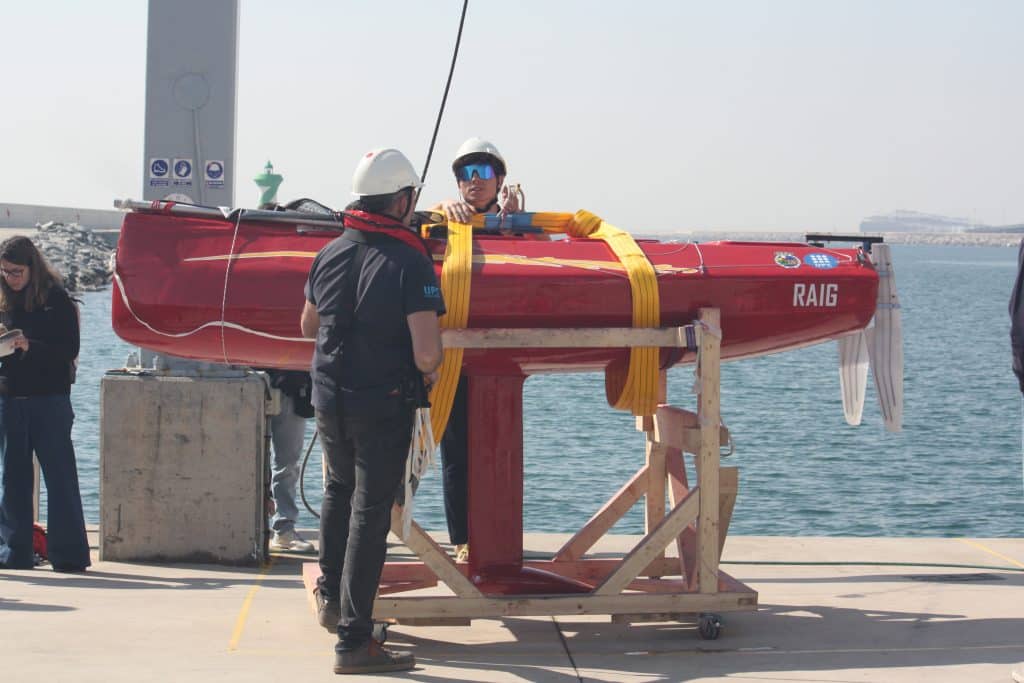
The rest of the build is worth understanding. The hull is fiberglass, 2.95 m LOA, 0.90 m beam, 0.98 m draft. Sail area is 3.5 m², mainsail and foresail trimmed simultaneously by a single custom linear actuator, a deliberate design choice to reduce autonomous control complexity.
Navigation runs on a hybrid control stack: a commercial autopilot handles rudder actuation and course-keeping, while a custom control unit manages sensor fusion and real-time route decisions. Inputs include a high-precision GPS, ultrasonic wind vane/anemometer, and AIS for collision avoidance. Shore communication uses GSM/4G plus VHF radio. Power is 100% solar. If the primary system fails, the autopilot holds a pre-configured fixed heading, not elegant, but it keeps the boat moving in the right direction. 26 students. 9 months. A boat that works.
Why we backed this
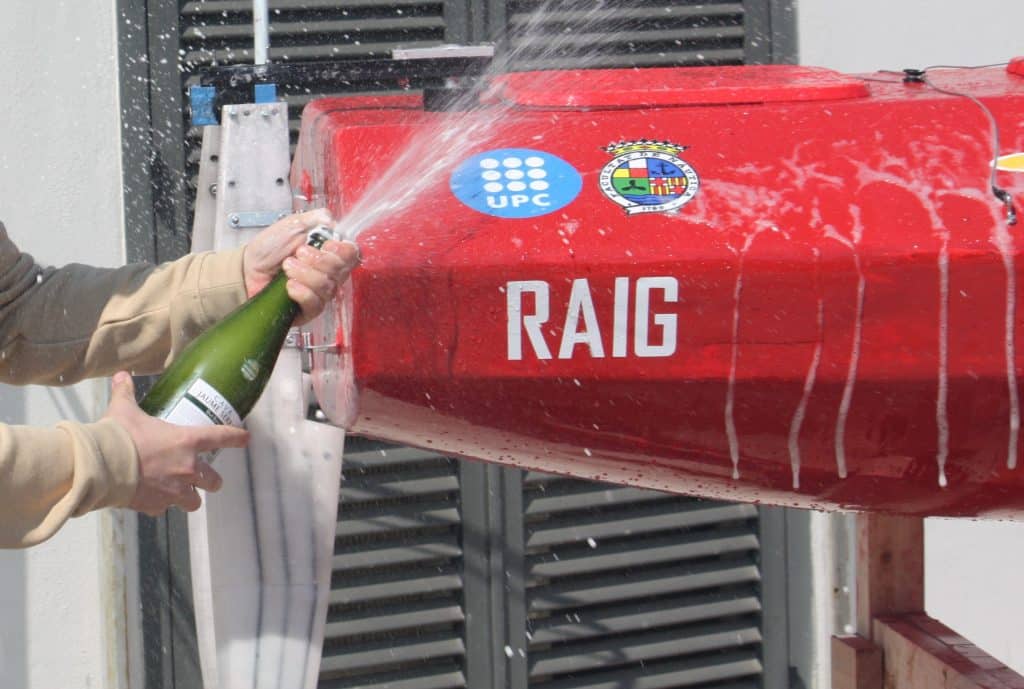
90% of global cargo moves by sea. The maritime sector accounts for roughly 3% of global GHG emissions. The Raig FNB is a small-scale proof of concept for autonomous, zero-emission short-sea shipping, and for us, a real-world testbed for CFIP components under conditions that a lab simply can’t replicate.
The final race is March 2027: Ibiza to the mainland, no crew, no assistance, 1 kg of salt on board. The rudders are ready.
Want to know more about the Raig FNB project? Read the full story on the UPC website: https://www.upc.edu/es/sala-de-prensa/noticias/se-presenta-raig-fnb-el-velero-autonomo-sostenible-disenado-y-construido-por-estudiantes-de-la-facultad-de-nautica-de-barcelona-de-la-upc